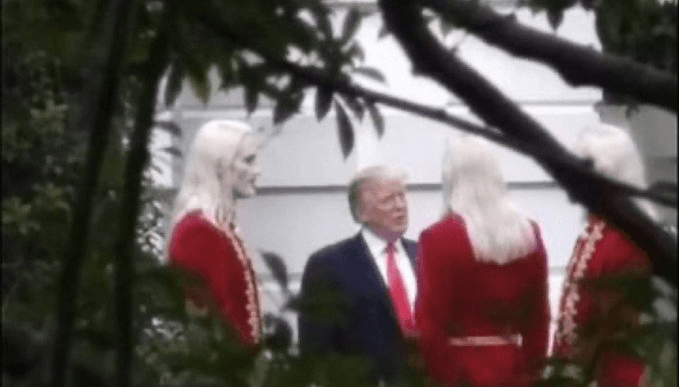
Let's get the obvious out of the way: no, three seven-foot platinum-haired figures in red theatrical coats did not meet the President on the White House lawn. The image — grainy, shot through conveniently blurry foliage, styled like a stolen long-lens press photo — is a fabrication, and not an especially subtle one.
So why did it reach 39 million views? Read the post that launched it:
"Posted and then almost instantaneously removed. What the literal hell is this?"
The engine of this hoax was never the picture. It was the deletion story. Something was posted. Someone removed it. What are they hiding? Notice what the post does not say: who posted it, where, or when. The attribution to the President's own account was added later, by the crowd. The mystery arrived unsourced — and unsourced mysteries are unfalsifiable.
The question nobody could answer
Five fact-checking organizations examined this image. All five could rule on the pixels. On the deletion story, the strongest any could say was: no evidence. Not false — unverifiable. There is a difference, and this case exists to teach it.
DAI separates the viral narrative into claims that can each be tested:
- The image shows a real event.
- The image is a fabricated depiction.
- An original post existed and was deleted — by the President's account.
- The figures were Norway's King's Guard (the viral "explanation").
What the evidence showed
The scene left no trace where real scenes leave traces. An outdoor presidential meeting with costumed foreign visitors belongs to one of the most heavily documented classes of event on earth. No schedule entry, no press-pool record, no second angle exists.
Neither did the image itself — until the claim. Here is the detail we find most instructive: after 39 million views, no one has produced a copy of this image older than the post that claims it was "deleted." We traced the earliest reverse-search matches ourselves; the most promising one, an Instagram repost, decodes — via the timestamp embedded in Instagram's own post IDs, a check any reader can reproduce — to twelve hours after the viral post. Crowds are excellent at spreading media and surprisingly bad at sourcing it.
The wardrobe wouldn't stay still. The decisive observation came not from a tool but from the analyst comparing renditions of the "same moment" side by side: in the wide shot, the figures wear plain red coats — no epaulettes, no belts. In a sharper circulating version, the same figures at the same meeting wear gold fringed epaulettes, dense chest embroidery, and gold belts. A real series of photographs of one moment does not change the uniform's hardware between frames. Independent AI generations of one prompt do — each render reinvents the details. There is also a 13-second video version in circulation, which explains the stills' frame-grab texture and points to generative video as the likely pipeline.
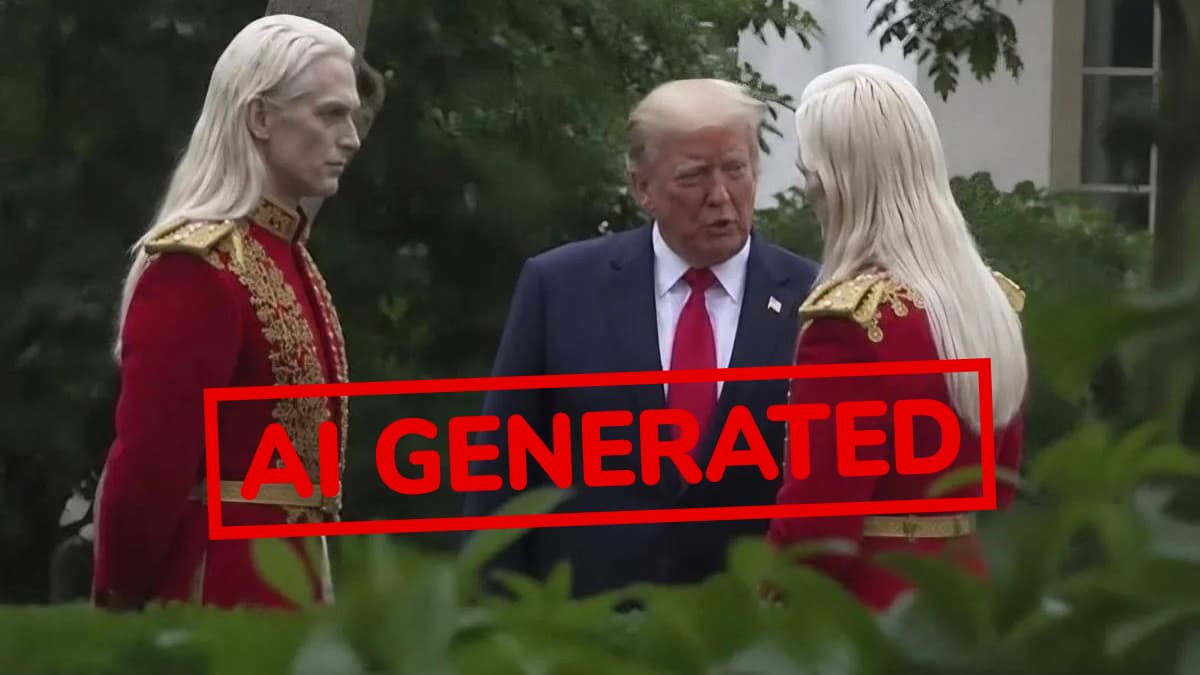
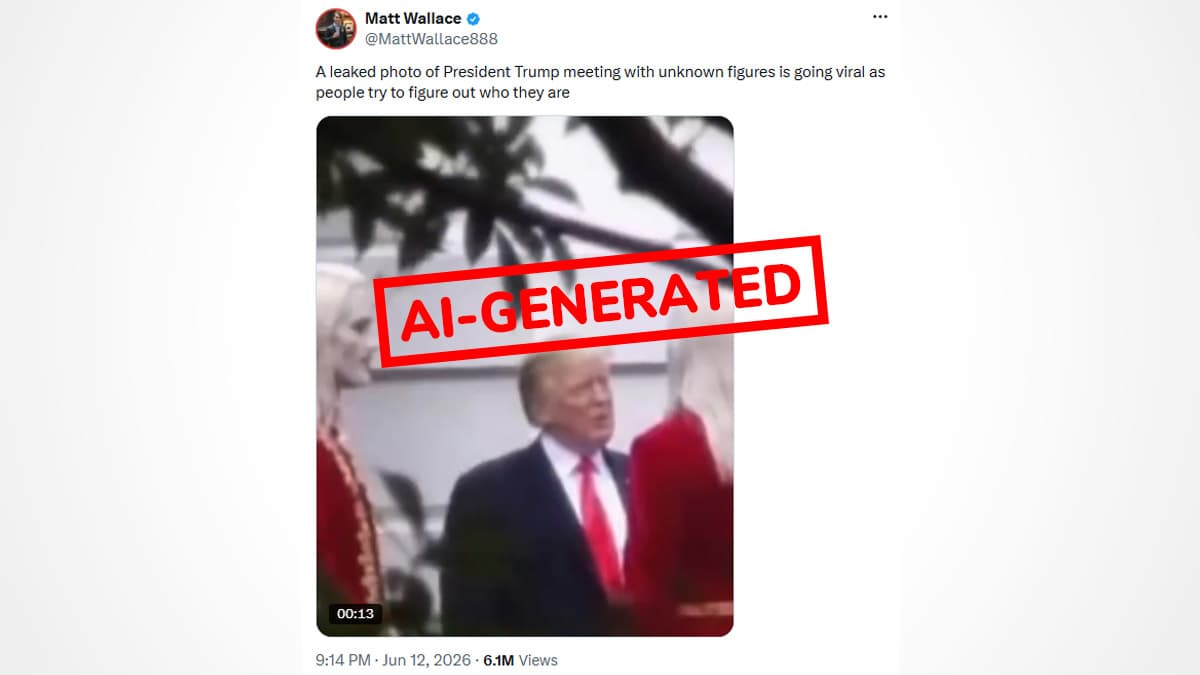
The AI detector said 0% — and that's not the exoneration it sounds like. The image classifier found no generative signature in the frame we analyzed — a known blind spot: single frames of AI video, recompressed by social platforms, routinely evade image classifiers. Meanwhile, press coverage cited a provenance watermark detection attributed to "a SynthID watermark originating from OpenAI" — attribution that is internally inconsistent (SynthID is Google DeepMind technology). This is the third case in this Casebook where provenance reporting was muddled in coverage meant to clarify it.
We checked the account the story eventually named. As the narrative matured, it specified a platform: the President's Truth Social profile. That account happens to be one of the most-archived social media accounts on earth — independent trackers poll it continuously, every few minutes, precisely to catch deletions. We swept an independent archive's complete record for June 11–13: thirty-six posts, every image and video identified — Iran statements, a proclamation, sculpture photos, a UFC video. The red-coated figures are not there. For the deletion story to be true, the post must have lived and died inside a blind spot of a few minutes, missed by every tracker watching.
And yet: that is still not "false." Archives capture what persists; a post allegedly live for seconds leaves no obligatory trace, and screenshots of "deleted posts" are trivially fabricated, so even a screenshot would prove nothing. No tool resolves this. The honest output is a verdict most verification culture refuses to issue: Indeterminate, leaning unsupported — with a precise list of what would change it: a dated archive capture of the original post, or a second tracker's deleted-post log confirming the silence.
The "explanation" was also false — three times over. The viral counter-claim that the figures were Norway's King's Guard collapses on every fact it touches: the unit's ceremonial dress is dark blue and black with green epaulettes, not red coats and platinum wigs (per the Norwegian Royal Court's own description); the "2019 Guardian report" it cited does not exist; and it called Norway's head of state a "president" — Norway is a monarchy. Even the debunk was misinformation, fabricated citation included.
The assessments
The image shows a real event
The image is a fabricated depiction
An original post existed and was deleted by the President's account
The figures were Norway's King's Guard
A note on the second row: it did not start at High. With the watermark reports unverifiable and the classifier at 0%, our corroboration rules held the fabrication finding at Moderate — on an image everyone "knows" is fake — until a fourth, independent line of evidence arrived: the wardrobe comparison across renditions. Obviousness never counted; evidence did. A discipline that lets obviousness substitute for evidence will eventually be confidently wrong about something that only looked obvious.
And note the third row. A fabricated image does not prove the posting story false. The posting story's unverifiability does not soften the fabrication finding. Collapse the two, and you hand the conspiracy its comeback: "they never actually proved the post didn't exist." They didn't. We say so.
What the tool got wrong — and why we publish that
Our own platform's headline for this file read "editorially processed image; no content changes found" — technically true (the file is identical to its earliest circulating copies) and dangerously easy to misread as clearance. A lineage answer was sitting in the seat where a claim-relevant answer belongs. The analyst caught it; the finding went into the platform's calibration record; the synthesis rule is being fixed. We publish this because a verification discipline that hides its own misfires is just another black box asking to be trusted.
The lesson
The most durable misinformation isn't the perfect fake. It's the claim built where evidence cannot follow — the deleted post, the private message, the thing "they" scrubbed. Against that genre, image forensics is beside the point. What's needed is the discipline to say, precisely: this part is fabricated; this part is unverifiable; here is what would change our mind — and the honesty to keep those verdicts separate.
---
Sources
| Source | URL | What it supports | Used for conclusion? |
|---|---|---|---|
| Analyzed specimen (SHA-256 1881a2ab…0ba7ddfb) | Archived in case file | Exact file analyzed | Yes |
| Viral X post (June 12, 2026 · 39M views) | https://x.com/ImBreckWorsham/status/2065455793059598646 | Claim documentation, verbatim text | Yes |
| Wayback capture (June 16, 2026) | https://web.archive.org/web/20260616104448/https://x.com/ImBreckWorsham/status/2065455793059598646 | Custody | Yes |
| Instagram re-circulation (decoded to June 13, 03:39 UTC) | https://www.instagram.com/p/DZguR94k6OP/ | Downstream circulation — not origin | Yes |
| IBTimes UK coverage | https://www.ibtimes.co.uk/mystery-trump-photo-sparks-online-debate-1802499 | Circulation context | Context |
| Fact-checks: Britannia Daily · LatestLY · Fact Crescendo · Factually.co · MEAWW | Linked in full report | Third-party corroboration; watermark reports (unverified) | Corroboration |
| Norway King's Guard ceremonial dress (Norwegian Royal Court) | https://www.royalcourt.no/the-royal-court/the-departments-the-royal-court/his-majesty-the-kings-guard | Disposal of the "explanation" claim (with two further grounds in the full report) | Yes |