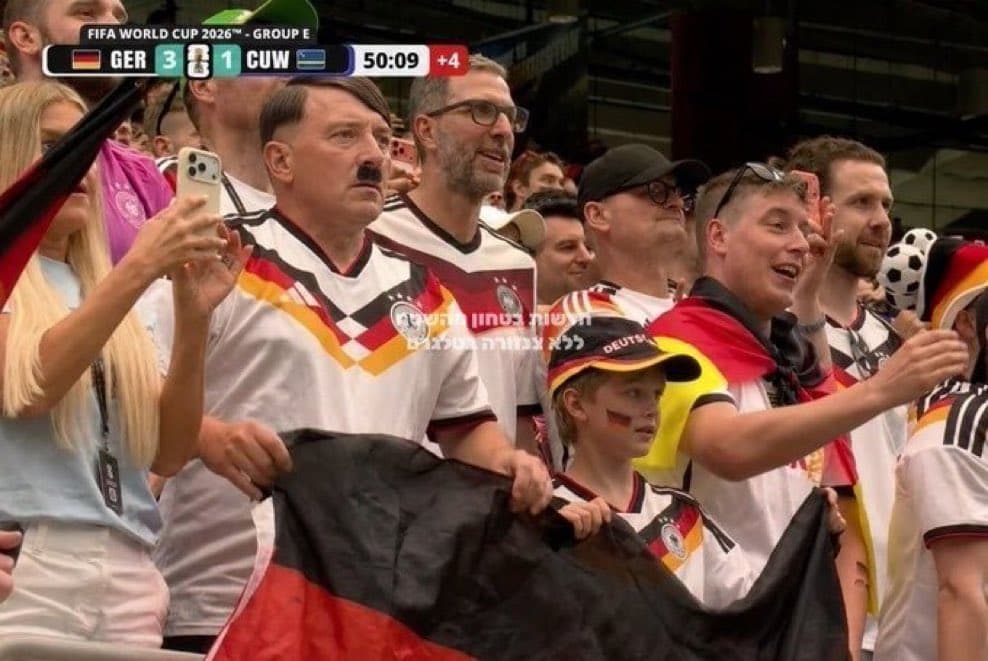
On June 14, 2026, during the FIFA World Cup match between Germany and Curaçao, an image began circulating on X, Facebook, Instagram, Threads and Reddit. It appeared to show a spectator resembling Adolf Hitler in the German crowd, captured by the live broadcast. One post alone passed 3 million views.
The question most people asked was the wrong one: "Is this image real?"
It has no single answer — because the image is real and the claim is false. This case shows why that distinction matters, and why a discipline built on claim-by-claim confidence assessment reaches conclusions that a "real vs. fake" detector cannot express.
What was actually claimed
Digital Authenticity Intelligence (DAI) begins every investigation by separating a viral assertion into claims that can each be tested against evidence. The caption — "a Hitler lookalike attended Germany's World Cup match" — contains three:
- The image is an unaltered capture of the broadcast.
- The person shown attended the match looking as depicted.
- The underlying scene — match, crowd, moment — really happened.
Most arguments about "fake images" collapse these into one question. They are not one question, and in this case they have opposite answers.
What the evidence showed
The scene is real. The image carries the broadcast score overlay — Group E, Germany 3, Curaçao 1, minute 50:09, four minutes of added time — which points to an exact, publicly checkable moment. FOX Sports' official extended highlights contain that moment. Frame-for-frame, the crowd matches the viral image person by person: the woman on the left, the man raising his phone, the child in the Deutschland bucket hat holding a flag, the fan in the #15 retro jersey. Same instant, same people, same positions.
Except one face. In the authentic broadcast frame, the spectator at the center is an ordinary grey-haired fan, clean-shaven, mouth open mid-cheer. In the viral image, the same man — same jersey, same posture — has dark side-parted hair, a toothbrush moustache, and a stern expression. Everything in the image matches the real broadcast except the one region that carries the viral claim.
The AI detector said 0%. Here is the detail that makes this case worth studying. When we ran the image through automated analysis, the AI-generation classifier returned a synthetic probability of zero percent. Technically defensible — the image was not generated from scratch; it is a real broadcast frame with a localized alteration. But quoted on its own, that score would have supported the false caption. "0% AI" is exactly what a binary verification culture would have shared as proof the image was authentic.
The file's silence proved nothing either way. The image contained no camera metadata — zero fields. For a frame captured from a broadcast and re-encoded by social platforms, that is entirely expected and tells us nothing about the claim. Treating missing metadata as evidence of tampering would have been just as wrong as treating the 0% score as evidence of authenticity. Reverse image search found the image circulating widely from June 14 onward, with fact-checking organizations among the top related sources.
The assessments
DAI does not issue verdicts of "real" or "fake." It issues confidence assessments, claim by claim:
The image is an unaltered broadcast capture
The person attended the match looking as depicted
The underlying broadcast moment is real
The evidence most strongly supports a straightforward conclusion: an authentic frame of the Germany–Curaçao broadcast was altered in one face region to make a spectator resemble Adolf Hitler, then redistributed with captions presenting it as authentic. No available evidence supports the presence of such a person at the match.
Independent fact-checks by France 24, Lead Stories, Euronews and Newsweek — consulted after our own analysis was documented — reached the same conclusion, and a Community Note was attached to the original post on X.
What remains unknown
Honest investigation documents its limits. We do not know who altered the image or with which tool; published reports of an embedded AI watermark could not be independently verified and differ on attribution. The viral X post is unlikely to be the first appearance: the file carries an overlaid watermark in Hebrew script whose legible portion references Telegram, indicating at least one earlier or parallel redistribution hop before the post that made it famous (see the source appendix in the full report). The trail behind that watermark remains open.

The lesson
TRST, our investigation platform, assisted with metadata characterization, synthetic-media signals, and circulation context. The decisive evidence came from analyst-led frame comparison against official broadcast footage. That division of labor is not a weakness of the method — it is the method. A small altered region in a heavily re-encoded social media file sits below what pixel-level detection can reliably see, and this case documents that openly rather than pretending otherwise.
The broader lesson is the one this Casebook exists to teach: authenticity is not a property of an image. It is a relationship between an image and a claim. This image was authentic as a record of a broadcast moment and false as evidence of who was in the crowd. Any verification approach that returns a single score — in either direction — was structurally incapable of telling you that.
Confidence is earned through the systematic reduction of relevant uncertainty. Sometimes what remains is the most important finding of all.
---